02 Sep 2025
From a great blog post out of Fred Rocha’s website (you can read an interview with him in Portugueseto Fumaça - an indie investigative journalism podcast):
Posting on our own websites is the way we have to counter Big Tech / Social Media conglomerates. We should all be doing it. You own your content, and people can subscribe to it, and you can follow their blogs / websites / instances as well. The alternative is an amalgamation of “content” tailored to make the uber-rich richer, and the regular people slaves to the algorithms and screens.
The antidote to Big Tech is Small Tech, Tech for the greater good that is individually owned and controlled. The Small Technology Foundation (a tiny NGO by Laura Kalbag and Aral Balkan) is building the tools for it.
Instead of hosting your content on a Big Tech platform that tracks you and those who consume your content, you host it on your own website. It can be as simple as a blog (as this blog for example) or a more complex digital garden (which includes public and private sections, and different applications). Doing it using technology that you know and control (and that does not control you).
That does not mean that you cannot share your content and creation elsewhere. My next blog post will be on exactly that, syndication.
Digital Gardens
Digital gardens are a form of small web. Maggie (who also has a beautiful website) wrote an essay on the history of digital gardens.
These usually take the form of personal wikis, shared with the world - wikis built over time, from the readings of each person,
aggregating and curating information that they absorbed. This also transposes to the Personal Knowledge Management (PKM) world.
Home Servers and DIY
I like to expand the notion of Small Web beyond the content of the website, to include creating the code that runs such website (like this example) and even managing infrastructure where the website runs.
Why make a home server?
because I can and because it’s fun are honestly the two biggest reasons. Everything else is just icing on the cake. (user -defron- on r/HomeServer reddit community)
A very DIY approach. You can make a hobby out of it, and the ultimate goal is to have fun and learn something. Maybe after you can teach someone who is running an activist campaign or support a local association with their digital “stuff”.
Hosting this blog
This blog is hosted on GitHub. I intend to move it elsewhere later down the line when I have the time.
Some Small web examples that I like
- https://retiredparkingguard.com/ - the personal webpage of Tor Erlend Fjelde, a PhD student in the Computational and Biological Learning (CBL). His website shows his personal notes on a variety of topics (his personal Digital Garden)
- https://www.noel-friedrich.de/terminal/ - the personal website of Noel Friedrich, in the form of a terminal. There are hundreds of commands implemented, games to play, a true realm of DIY examples.
- https://maggieappleton.com/ - Maggie Appleton’s personal website, a digital garden with a lot of interesting essays and drawings.
13 Jun 2025
The Fediverse (commonly shortened to fedi) is a collection of social networking services that can communicate with each other (formally known as federation) using a common protocol. Users of different websites can send and receive status updates, multimedia, files and other data across the network. The term Fediverse is a portmanteau of federation and universe.
Thank you, Wikipedia. I recommend these two videos bellow to know more about the Fediverse (they are short, I promise).
What is the Fediverse?
Introducing the Fediverse, by Elena Rossini
After this quick introduction, I want to focus on what are the main advantages in my optics. A lot of people got exposed to the Fediverse via Mastodon, when Musk bought Twitter, because Mastodon is a microblogging service similar to Twitter safe from hostile takeovers (unlike Threads or Bluesky, other similar services).
The reason why Mastodon is safe from such scenarios is that unlike the closed platforms of Facebook, Twitter, YouTube, Threads, Bluesky, Instagram or TikTok, the content and the users on Mastodon are not held by a centralized service provider (Meta, Twitter, Google, TikTok, …). Instead, Mastodon is a federated service, ran by multiple distributed instances. Each instance owner moderates its content according to their preferences. So when you join, you need to choose which instance you want to belong to.
But also because Mastodon (and other services on the Fediverse) supports ActivityPub this means that you can choose to see (or block) content from other instances. This decentralizes the content ownership, and that’s why it is called a decentralized solution (do not confuse with cryptocurrencies just because they share this property).
Each instance owner can enact their own rules and chose which other instances (or federation members) to allow or block. So if the rules change (like it happened with Twitter, were suddenly hate speech started to appear) you can move, and you can block instances poorly moderated (or moderated against your beliefs).
So you can have state-sponsored instances (which practice different censorship laws) and NGO-sponsored instances and individual or community-ran instances. Instances can allow for new members, or to be invite-only, or closed to new members.
Finally, unlike Facebook, Instagram, Twitter, TikTok and others, Mastodon does not track you, does not try to sell you adds, or mess with your feed using obscure algorithms. It is tech that you can trust.
Beyond Mastodon
The fediverse is more than just Mastodon. What is common to all of them is that they support the ActivePub protocol. They are all social platforms that all have users, content and followers, and they compose the Fediverse.
Usually these services are Free and open-source software (FOSS). Being FOSS allows anyone to run their instance and also allow for auditing of the code, so the users can trust the technology they are using (one of the Digital Vegan action items that I mentioned on my last post).
Examples of other software on the Fediverse:
- FediTube (alternative to YouTube)
- PixelFed (alternative to Instagram)
- BookWyrm (alternative to Goodreads)
- Mobilizon, for event planning
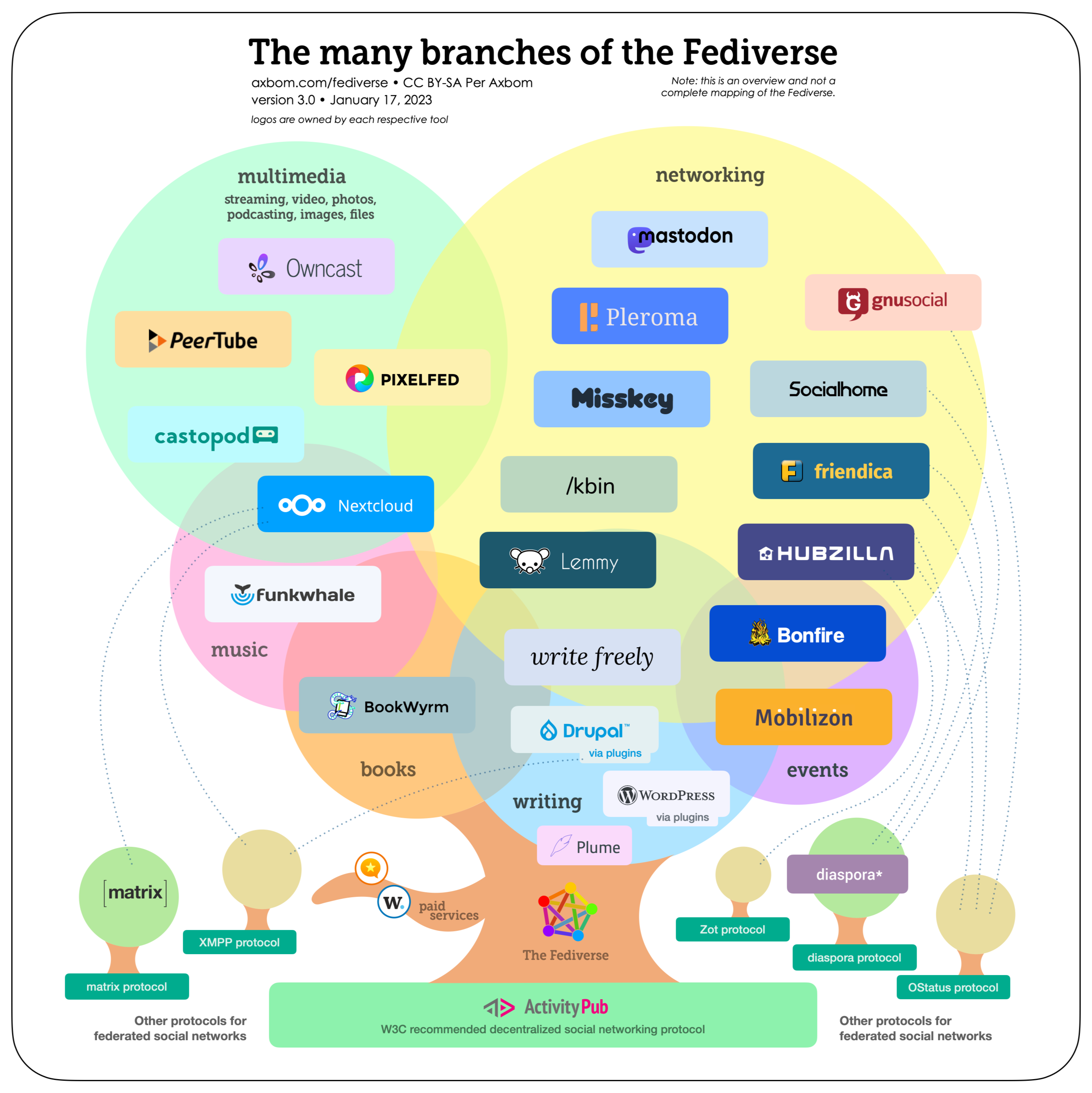
Image Source
Bluesky, a commercial operator, has built their version of ActivityPub, the AT protocol. While Bluesky does not support ActivityPub, since 2024 users on both platforms can communicate because these protocols are interoperable using BridgyFed. Another commercial operator open to the Fediverse is WordPress, via plugin.
FediForum Conference
This month the FediForum conference took place. It brings together people building the new Open Social Web, and it states “Open protocols, not closed platforms”.
One of the news is that the makers of Bridgy Fed created Bounce, a tool that allows you to move your following between Bluesky and Mastodon.
Conclusion
All of this is possible because people are choosing solutions that support open protocols over closed platforms.
If you want to dig deeper into alternative internet and decentralized solutions for domains other than social networks, check the alternative internet repo.
Ready to join the Fediverse? Go to https://jointhefediverse.net/ to start! And follow me on Mastodon @dzarmo@nerdculture.de (notice the second @? That’s the instance where my account lives).
05 Jun 2025
Digital Veganism is a movement of which the Digital Vegan book, written by Dr. Andy Farnell is part of.
This post is not a book review. It is about the movement, and the principles and ideas shared by Andy.
Digital Veganism promotes a deliberate use of technology, avoiding “toxic” (or unethical) products, similar in ways to veganism. In the words of the author, “[This book] is a call to disengagement and more careful, slower, deliberate and thoughtful relationships with technology”.
Surveillance capitalism, as described by Shoshana Zuboff is driven by a profit-making incentive, and arose as advertising companies, led by Google’s AdWords, saw the possibilities of using personal data to target consumers more precisely. Her book on the topic extensively documents the exploitative practices of Big Tech.
Research on the psychological effects of social media generally agrees (see note 1) on its negative effects, especially on teenagers. That is the subject of last-year’s book
The Anxious Generation, from Jonathan Haidt. Facebook was under fire a few years ago about results from their own internal investigation. Don’t forget that tech moguls don’t let their kids use smartphones.
Closed platforms like Facebook and Twitter monitor and spy on their users (even outside of their domains with buttons embedded on other websites, example from this week). They collect the most information possible (even outside of their platform, even about people who are not users) and show the most engaging content (regardless of the physiologic impact on users or damages to society) to keep their users attention and show them the best adds possible, while at the same time making it impossible to consume their content outside of their platform. This is unethical tech and the type of tech Digital Vegans avoid.
Some action items for digital veganism, from the “Resources and Actions” chapter are the following:
- Always retain control over your technology (do not use software or hardware products from Big Tech companies who treat you as a resource to be exploited, instead of a customer)
- Boycott stores and services that use unethical digital products and algorithms.
- Use online resources created by whistle-blowers and ethical hackers to find which institutions engage in unethical practices. If you have time, use the law to make it difficult for technology abusers.
- Think about who makes and disposes of your technology. Buy ethical hardware if possible.
- Use cash and anonymous payment methods.
- In general, try to reuse older hardware and software which is simpler and time tested (boring is better)
- Experiment with digital detox.
- Most of all, educate yourself.
We need an escape from all this control. Technofascism is around the corner, and the only thing worse than a corporation that knows everything about you is a state. A database as rich as Facebook’s is useful for any authoritarian government to round up their opposition, and it is not hard for the data to fall on the wrong hands (as many data breaches have shown over the years).
There are alternatives, maybe not so shiny but certainly more respectful. Choosing better platforms is a way to act. I expect to write about these on future posts. Another way is to chose protocols over platforms (you can read here the seminal essay from Mike Masnick).
Why is it that we can email (a protocol) anyone with an email address, independently of their email provider (Gmail, Hotmail, Yahoo, ProtonMail) but we cannot send an instant message from Telegram to our friend that uses WhatsApp (platforms)?
These closed platforms and walled gardens may seem unavoidable and inescapable today. “Everyone has an Instagram/Whatsapp/Gmail account”. But just 10 years ago Facebook was thriving with content from millennials, and today it is a desert. These platforms only exist while people use them, while we choose to give them our attention. We can divert away to places that treat us better.
This goal of this blog post is not to convince you to became a Digital Vegan. That requires you making your own research and the book from Dr. Andy Farnell does a much better job than ever could. He even addresses the main criticisms on the chapter “Objections”.
The goal here is to spread the message, to share with others with similar interests that we are here, resisting. Struggling to build a better future.
References
- Nagata JM, Otmar CD, Shim J, et al. Social Media Use and Depressive Symptoms During Early Adolescence. JAMA Netw Open. 2025;8(5):e2511704. doi:10.1001/jamanetworkopen.2025.11704
- Digital Vegan, Andy Farnell, 2021
- The Age of Surveillance Capitalism, Shoshana Zuboff, 2019
- The Anxious Generation, Jonathan Haidt, 2024
- Protocols, Not Platforms: A Technological Approach to Free Speech, Mike Masnick 2019, https://knightcolumbia.org/content/protocols-not-platforms-a-technological-approach-to-free-speech
11 May 2025
On building the blog
Setting the development Environment
- Install Jekyll
gem install jekyll bundler
ERROR:  Error installing jekyll:
        The last version of ffi (~> 1.0) to support your Ruby & RubyGems was 1.17.2. Try installing it with `gem install ffi -v 1.17.2` and then running the current command again
        ffi requires RubyGems version >= 3.3.22. The current RubyGems version is 3.1.2. Try 'gem update --system' to update RubyGems itself.
Fetching bundler-2.6.8.gem
ERROR:  Error installing bundler:
        The last version of bundler (>= 0) to support your Ruby & RubyGems was 2.4.22. Try installing it with `gem install bundler -v 2.4.22`
        bundler requires Ruby version >= 3.1.0. The current ruby version is 2.7.0.0.
I had to update the gems using sudo gem update. gem update --system didn’t work.
The solution was to install a new rube version with rvm.
rvm install 3.2.2
Running the site
bundle exec jekyll serve --livereload
Theme
https://github.com/poole/hyde
